Delivering Digital Transformation, Business Transformation and Legal Compliance

Cees Van der Vlugt


Subscribe Contact us

Authors


Why Digital Transformation & Business Transformation Must Come Together


Transformation is at the heart of everything we do at Cambridge Management Consulting, and we have always recognised the importance of combining digital transformation (using digital capabilities to modify operations) with business transformation (a significant redesign of your operating model).


70-80% of digital transformation initiatives fail to realise their predicted value. Our experience shows that integrating digital and business transformation is an essential feature of delivering successful transformation and significantly reduces the risks of failure.


Put simply, digital transformation must include business transformation to ensure change initiatives achieve lasting strategic outcomes.


As a consultancy that was founded on principles and lessons learned in decades of complex transformation projects, we strongly emphasise developing a people strategy for  your transformation. This is often overlooked, and companies still fail to realise that they pay a high price for focussing exclusively on changing systems and processes.


Consequently, your digital transformation strategy should also include an assessment of the change readiness of your workforce and its resilience.

SERVICE INFO
crowd of people

What is Change Readiness and How to Measure it


Change readiness measures how prepared and able your workforce is for a specific change. The results indicate whether you can expect high or low employee resistance, the reasons behind those barriers, and it provides the Board with a reality check on estimated change timelines and expected completion.


Every organisation has unique conditions that can make change management easier or much more challenging. Understanding these attributes will enable your management teams to predict potential obstacles and plan ahead.


A typical assessment includes:


  • Culture and value systems
  • How much change has already taken place or is taking place
  • Leadership styles and power dynamics
  • Positive and negative effects of past changes
  • Attitudes toward the change initiative
  • Workforce resilience
Down the Drain

The Importance of Building Workforce Resilience Prior to Business Transformation


Workforce resilience refers to a work environment in which employees can easily adapt to challenging situations, manage stress, and stay motivated. There are a number of indicators that positively influence workforce resilience:


  1. Early Workforce participation in the change process through established representation guidelines, or in its absence, by proactive company invitation

  2. Involvement of the workforce in actively developing the change solution

  3. Early understanding how roles will change and how skills gaps to fulfil the new roles will be addressed by the company

  4. Early understanding how the company will deal with workforce reductions


To gather information on workforce resilience, we recommend you use an experienced third-party. There are many different methods such as tracking polls and pulse surveys; and increasingly, the use of artificial intelligence (AI) and automated tools that use sentiment analysis.


Depending on the outcome of the above assessments, you may choose to continue or revisit the timing of your business transformation initiatives. If change readiness is found lacking, we can deliver an action plan to help prepare your workforce for the specific changes ahead.


To foster the concept of workforce resilience, you may need to review your values and culture, and provide additional training to management, team leaders and employees.


Providing opportunities for employee feedback and participation in decision-making will help to improve employee experience in your company and an employee desire to contribute to the investment in the company's longer term business success. It cannot be stressed enough that communicating any upcoming change is crucial, as is the need to include employees in your transformation journey.


Start early and offer ongoing training and development opportunities to support employee growth and success throughout digital and business transformation.

Push the Button

Our Unique Focus on People, Processes, and Compliance


Cees Van der Vlugt is a recognised expert in international business transformation, HR and Human Capital Management (HCM). With decades of experience in the Human Resources environment and organisational restructuring, he created our transformation triangle model to deliver digital transformation with the inclusion of business transformation and legal compliance.


This model also includes a strong focus on change readiness, early involvement of the people in your business and stronger governance of a multi-functional consultancy team in delivering a customer centric solution.


The Model was, in its first instance, developed and tested in the German Market, where strong compliance demands are made by Works Councils Legislation. After successful testing in this strict market, it has been expanded to all geographies.


To further complement our service in Germany, we have engaged a legal partner, Pusch Wahlig Workplace Law (PWWL). PWWL is part of a global network of law firms and they support our clients by making sure business changes are implemented with the right level of legal transformation and compliance, with a focus on delivering a customer centric solution with the Transformation Triangle Team.

Dr Tobias Brors, Pusch Wahlig Workplace Law, says "what I like about the partnership between Pusch Wahlig and Cambridge Management Consulting is the solution orientation and customer-centric approach that both companies embrace in their engagement with clients"

How Our Model Addresses the Failure Rate of Digital Transformation


Cees has first-hand experience of the many challenges that come with digital transformation. His business experience has taught him that companies will, without doubt, face an uphill struggle to turnaround their digital capability if the delivery strategy does not include people (Human Capital) from the beginning of the transformation journey.


Furthermore, it is not only early involvement, but also a lack of understanding of change readiness levels in your workforce that can bring digital transformation to a grinding halt. Whether it is the resilience of your workforce, or the efficiency of your processes and procedures, every part of your operating model must be ready to sustain the impact of digital change.


An operating model that fully aligns with the anticipated digital change in your company is often an undervalued element in the process. Without full alignment between proposed digital transformation and operating models, your organisational capability can only reflect the past and present, but not the future.


When these shortfalls are compounded by (legacy) localised process design, lack of communication, and weak training strategies, you will start to see diminishing results and growing resistance from your workforce. The longer this continues, the less chance you have of realising the strategic advantages of your transformation.

The Triangle of Transformation Model
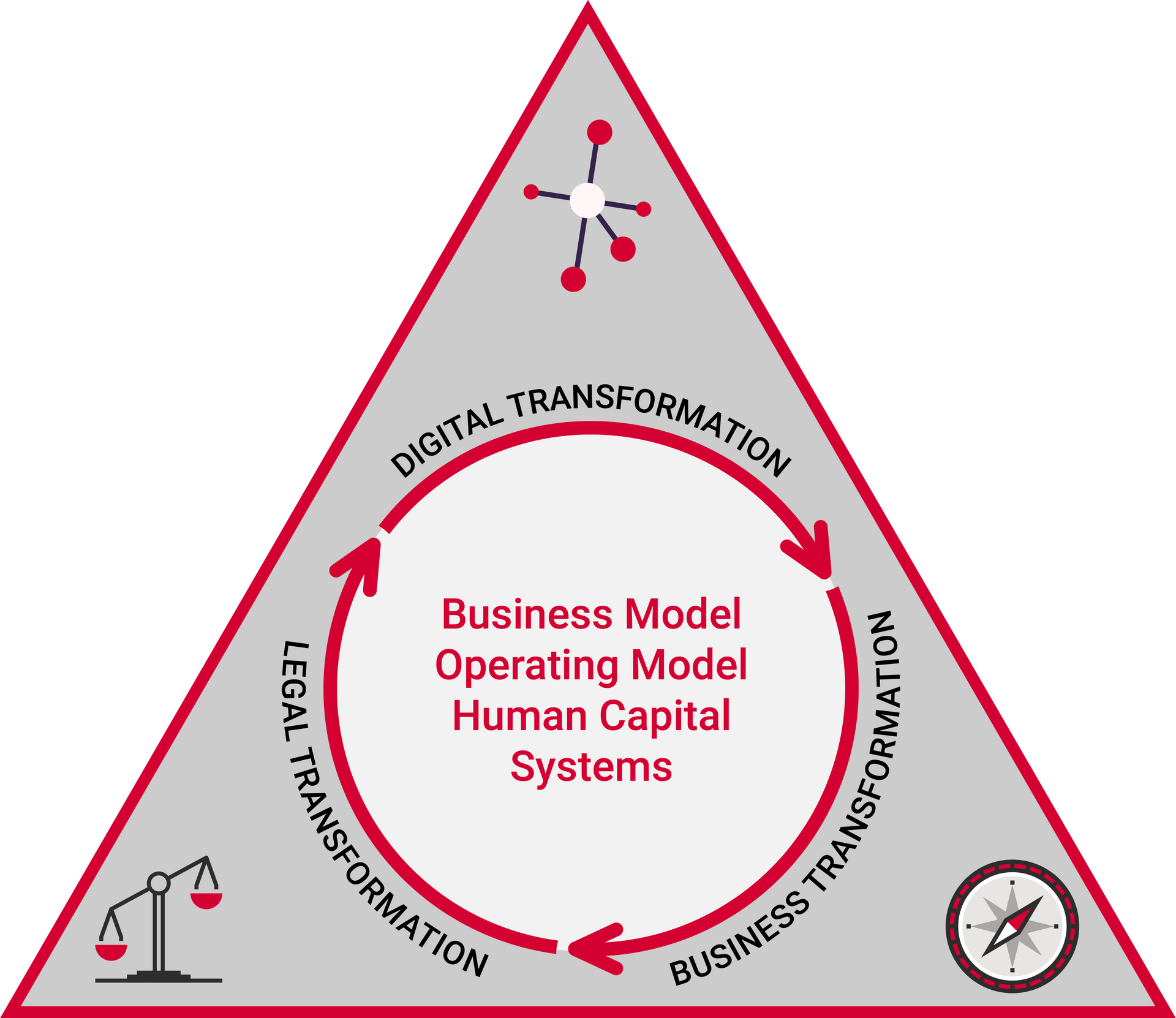
Cees has created a digital and business transformation service that is based on a pre-defined partnership between the providers of digital transformation, business transformation and legal transformation. The emphasis is on driving a customer centric solution through an agreed multi-functional approach, reducing the impact of siloed expertise and substandard solutions. 


Multi-functional disciplines are fully aligned with our planning, design, consultancy and implementation services and we work through creating a Transformation Triangle of essential resources that drive a customer-centric, lasting, and efficient change.


There are many reasons why we believe this blended approach is essential to produce the best results.


By combining multi–discipline external expertise into a customer-centric orientated team we reduce the complexity of fragmented support and we can increase our focus on delivering the transformation rather than being pulled into the bureaucracy that surrounds fragmented partnerships.


Yet that is not the only unique strategy employed by our model. As discussed earlier, one common cause of failure during digital transformation is not having a strategy for the people side of your business and not starting early enough.


Our approach continuously balances the employee and business interests. Having an employer and employee representation approach that abstains from technical rationality promotes a sustainable transformation journey.

According to Dr Tobias Brors, Pusch Wahlig, "the development of the Cambridge Management Consulting Transformation Triangle would be a great step in the direction of more effective engagements with Works Councils and the approach could certainly lead to benefits for both employers and Works Councils."

How the German Market Created Our Unique Scalable Model


Cees believes that a model for the German market delivers a scalable solution for international clients. Germany operates a complex set of legislation that needs to be adhered to before making changes to IT infrastructure; and it is specific about the decision-making powers given to German Works Councils, particularly when changes to IT infrastructure affect employees and existing operating models.


This makes it the perfect place to build a scalable model: “A developed business transformation solution for Germany, with its complex employee relations environment, gives us the model from which we can adapt business transformation solutions for other countries with more lenient institutional employee representation.”

Our Legal Partnership with Pusch Wahlig Workplace Law (PWWL)


For legal expertise and legal integrity in the German Market we engaged Pusch Wahlig Workplace Law (PWWL). In collaboration with PWWL, we focus on driving effective labour law solutions, while balancing the customer’s desired digital transformation aspirations and the interests of institutional employee representation.


In the Triangle approach, PWWL provides the vital legal support to implement digital transformation solutions. PWWL is a great example of the kind of law firm that matches our ambitions. The firm is innovative and at the forefront of developments and trends in the field of workplace law in Germany, and strongly connected with digital and business transformation.


PWWL is a leading German employment and labour law firm, with more than 60 highly qualified labour and employment law specialists. Three-time winner of Employment Law Firm of the Year in Germany, they offer clear, concise, goal-oriented solutions in the highly regulated realm of German labour and employment law. With a focus on communicative working relationships, they are a firm driven by proactive strategies which produce results.


PWWL is a member of L&E Global, an alliance of employers’ counsel worldwide. Through our PWWL partnership we also have access to this Global Law Firm Network. L&E is the worldwide leader for cross-border labour and employment law services. Spanning 6 continents, L&E Global member firms are ideally situated to provide clients with the pragmatic, commercial advice necessary to achieve their objectives, wherever they operate.


We feel proud to showcase and be supported by the amazing people that we work with. Digital transformation is full of exciting possibilities and our cutting-edge model and legal support can make it happen for you.


To read more about our Business Transformation capability, go to our service page.


To find out more about our combined Digital Transformation, Business Transformation and Legal Services, contact Cees Van der Vlugt for a free consultation.

About Us


Cambridge Management Consulting (Cambridge MC) is an international consulting firm that helps companies of all sizes have a better impact on the world. Founded in Cambridge, UK, initially to help the start-up community, Cambridge MC has grown to over 120 consultants working on projects in 18 countries. Our capabilities focus on supporting the private and public sector with their people, process and digital technology challenges.


What makes Cambridge Management Consulting unique is that it doesn’t employ consultants—only senior executives with real industry or government experience and the skills to advise their clients from a place of true credibility. Our team strives to have a highly positive impact on all the organisations they serve. We are confident there is no business or enterprise that we cannot help transform for the better.


Cambridge Management Consulting has offices or legal entities in Cambridge, London, New York, Paris, Singapore and Helsinki, with further expansion planned in the near future.


Find out more about our people services and full list of capabilities.

Subscribe to our Newsletter

Blog Subscribe

SHARE CONTENT

Neon letters 'Ai' made from stacks of blocks like a 3D bar graph
by Darren Sheppard 4 December 2025
What is the Contract Lifecycle Management and Why does it Matter? The future success of your business depends on realising the value that’s captured in its contracts. From vendor agreements to employee documents, everywhere you look are commitments that need to be met for your business to succeed. The type of contract and the nature of goods or services it covers will determine what sort of management activities might be needed at each stage. How your company is organised will also determine which departments or individuals are responsible for what activities at each stage. Contract Lifecycle Management, from a buyer's perspective, is the process of defining and designing the actual activities needed in each stage for any specific contract, allocating ownership of the activities to individuals or groups, and monitoring the performance of those activities as the contract progresses through its lifecycle. The ultimate aim is to minimise surprises, ensure the contracted goods or services are delivered by the vendor in accordance with the contract, and realise the expected business benefits and value for money. The Problem of Redundant Spend in Contracts Despite the built-in imbalance of information favoring suppliers, companies still choose to oversee these vendors internally. However, many adopt a reactive, unstructured approach to supplier management and struggle to bridge the gap between contractual expectations and actual performance. Currently, where governance exists, it is often understaffed, with weak, missing, or poorly enforced processes. The focus is primarily on manual data collection, validation, and basic retrospective reporting of supplier performance, rather than on proactively managing risk, relationships, and overall performance. The amount of redundant spend in contracts can vary widely depending on the industry, the complexity of the contracts, and how rigorously they are managed. For further information on this, Cambridge MC’s case studies provide insights into typical ranges and common sources of redundant spend. As a general estimate, industry analysts often state that redundant spend can account for as much as 20% of total contract value. In some cases, especially in poorly managed contracts, this can be much higher. What is AI-driven Contract Management? Artificial Intelligence (AI) is redefining contract management, transforming a historically time-consuming and manual process into a streamlined, efficient, and intelligent operation. Traditionally, managing contracts required legal teams to navigate through extensive paperwork, drafting, reviewing, and monitoring agreements — a process prone to inefficiencies and human error. With the emergence of artificial intelligence, particularly generative AI and natural language processing (NLP), this area of operations is undergoing a paradigm shift. This step change is not without concerns however, as there are the inevitable risks of AI hallucinations, training data biases and the threat to jobs. AI-driven contract management solutions not only automate repetitive tasks but also uncover valuable insights locked up in contract data, improving compliance and reducing the risks that are often lost in reams paperwork and contract clauses. Put simply, AI can automate, analyse, and optimise every aspect of your contract lifecycle. From drafting and negotiation to approval, storage, and tracking, AI-powered platforms enhance precision and speed across these processes; in some cases reducing work that might take several days to minutes or hours. By discerning patterns and identifying key terms, conditions, and concepts within agreements, AI enables businesses to parse complex contracts with ease and efficiency. In theory, this empowers your legal and contract teams (rather than reducing them), allowing personnel to focus on high-level tasks such as strategy rather than minutiae. However, it is important to recognise that none of the solutions available in the marketplace today offer companies an integrated supplier management solution, combining a comprehensive software platform, capable of advanced analytics, with a managed service. Cambridge Management Consulting is one of only a few consultancies that offers fully integrated Contract Management as a Service (CMaaS). Benefits of Integrating AI into your Contract Lifecycle Management Cambridge MC’s Contract Management as a Service (CMaaS) 360-degree Visibility: Enable your business to gain 360-degree visibility into contracts and streamline the change management process. Real-time Data: Gain real-time performance data and granularly compare it against contractually obligated outcomes. More Control: Take control of your contracts and associated relationships with an integrated, centralised platform. Advanced meta data searches provide specific information on external risk elements, and qualitative and quantitative insights into performance. Reduces Costs: By automating manual processes, businesses can significantly reduce administrative costs associated with contract management. AI-based solutions eliminate inefficiencies in the contract lifecycle while minimising reliance on external legal counsel for routine tasks. Supplier Collaboration: Proactively drive supplier collaboration and take a data-driven approach towards managing relationships and governance process health. Enhanced Compliance: AI tools ensure that contracts adhere to internal policies and external regulations by flagging non-compliant clauses during the drafting or review stage. This proactive approach reduces the risk of costly disputes or penalties. Reduces Human Errors: In traditional contract management processes, human errors can lead to missed deadlines and hidden risks. AI-powered systems use natural language processing to identify inconsistencies or inaccuracies in contracts before they escalate into larger issues. Automates Repetitive Tasks: AI-powered tools automate time-consuming tasks such as drafting contracts, reviewing documents for errors, and extracting key terms. This frees up legal teams to focus on higher-value activities like strategic negotiations and risk assessment. We can accurately model and connect commercial information across end-to-end processes and execution systems. AI capabilities then derive and apply automated commercial intelligence (from thousands of commercial experts using those systems) to error-proof complex tasks such as searching for hidden contract risks, determining SLA calculations and performing invoice matching/approvals directly against best-in-class criteria. Contract management teams using AI tools reported an annual savings rate that is 37% higher than peers. Spending and tracking rebates, delivery terms and volume discounts can ensure that all of the savings negotiated in a sourcing cycle are based on our experience of managing complex contracts for a wide variety of customers. Our Contract Management as a Service, underpinned by AI software tooling, has already delivered tangible benefits and proven success. 8 Steps to Transition Your Organisation to AI Contract Management Implementing AI-driven contract management requires a thoughtful and structured approach to ensure seamless integration and long-term success. By following these key steps your organisation can avoid delays and costly setbacks. Step 1 Digitise Contracts and Centralise in the Cloud: Begin by converting all existing contracts into a digital format and storing them in a secure, centralised, cloud-based repository. This ensures contracts are accessible, organised, and easier to manage. A cloud-based system also facilitates real-time collaboration and allows AI to extract data from various file formats, such as PDFs and OCR-scanned images, with ease. Search for and retrieve contracts using a variety of advanced search features such as full text search, Boolean, regex, fuzzy, and more. Monitor upcoming renewal and expiration events with configurable alerts, notifications, and calendar entries. Streamline contract change management with robust version control and automatically refresh updated metadata and affected obligations. Step 2 Choose the Right AI-Powered Contract Management Software: Selecting the right software is a critical step in setting up your management system. Evaluate platforms based on their ability to meet your organisation’s unique contracting needs. Consider key factors such as data privacy and security, integration with existing systems, ease of implementation, and the accuracy of AI-generated outputs. A well-chosen platform will streamline workflows while ensuring compliance and scalability. Step 3 Understand How AI Analyses Contracts: To make the most of AI, it’s essential to understand how it processes contract data. AI systems use Natural Language Processing (NLP) to interpret and extract meaning from human-readable contract terms, while Machine Learning (ML) enables the system to continuously improve its accuracy through experience. These combined technologies allow AI to identify key clauses, conditions, and obligations, as well as extract critical data like dates, parties, and legal provisions. Training your team on these capabilities will help them to understand the system and diagnose inconsistencies. Step 4 Maintain Oversight and Validate AI Outputs: While AI can automate repetitive tasks and significantly reduce manual effort, human oversight is indispensable. Implement a thorough process for spot-checking AI-generated outputs to ensure accuracy, compliance, and alignment with organisational standards. Legal teams should review contracts processed by AI to verify the integrity of agreements and minimise risks. This collaborative approach between AI and human contract management expertise ensures confidence in the system. Step 5 Refine the Data Pool for Better Results: The quality of AI’s analysis depends heavily on the data it is trained on. Regularly refine and update your data pool by incorporating industry-relevant contract examples and removing errors or inconsistencies. A well-maintained data set enhances the precision of AI outputs, enabling the system to adapt to evolving business needs and legal standards. Step 6 Establish Frameworks for Ongoing AI Management: To ensure long-term success, set clear objectives and measurable goals for your AI contract management system. Define key performance indicators (KPIs) to track progress and prioritise features that align with your organisation’s specific requirements. Establish workflows and governance frameworks to guide the use of AI tools, ensuring consistency and accountability in contract management processes. Step 7 Train and Empower Your Teams: Equip your teams with the skills and knowledge they need to use AI tools effectively. Conduct hands-on training sessions to familiarise users with the platform’s features and functionalities. Create a feedback loop to gather insights from your team, allowing for continuous improvement of the system. Avoid change resistance by using change management methodologies, as this will foster trust in the technology and drive successful adoption. Step 8 Ensure Ethical and Secure Use of AI: Tools Promote transparency and integrity in the use of AI-driven contract management. Legal teams should have the ability to filter sensitive information, secure data within private cloud environments, and trace data back to its source when needed. By prioritising data security and ethical AI practices, organisations can build trust and mitigate potential risks. With the right tools, training, and oversight, AI can become a powerful ally in achieving operational excellence as well as reducing costs and risk. Overcoming the Technical & Human Challenges While the benefits are compelling, implementing AI in contract management comes with some unique challenges which need to be managed by your leadership and contract teams: Data Security Concerns: Uploading sensitive contracts to cloud-based platforms risks data breaches and phishing attacks. Integration Complexities: Incorporating AI tools into existing systems requires careful planning to avoid disruptions and downtime. Change Fatigue & Resistance: Training employees to use new technologies can be time-intensive and costly. There is a natural resistance to change, the dynamics of which are often overlooked and ignored, even though these risks are often a major cause of project failure. Reliance on Generic Models: Off-the-shelf AI models may not fully align with your needs without detailed customisation. To address these challenges, businesses should partner with experienced providers who specialise in delivering tailored AI-driven solutions for contract lifecycle management. Case Study 1: The CRM That Nobody Used A mid-sized company invests £50,000 in a cutting-edge Customer Relationship Management (CRM) system, hoping to streamline customer interactions, automate follow-ups, and boost sales performance. The leadership expects this software to increase efficiency and revenue. However, after six months: Sales teams continue using spreadsheets because they find the CRM complicated. Managers struggle to generate reports because the system wasn’t set up properly. Customer data is inconsistent, leading to missed opportunities. The Result: The software becomes an expensive shelf-ware — a wasted investment that adds no value because the employees never fully adopted it. Case Study 2: Using Contract Management Experts to Set Up, Customise and Provide Training If the previous company had invested in professional services alongside the software, the outcome would have been very different. A team of CMaaS experts would: Train employees to ensure adoption and confidence in using the system. Customise the software to fit business needs, eliminating frustrations. Provide ongoing support, so issues don’t lead to abandonment. Generate workflows and governance for upward communication and visibility of adherence. The Result: A fully customised CRM that significantly improves the Contract Management lifecycle, leading to: more efficient workflows, more time for the contract team to spend on higher value work, automated tasks and event notifications, and real-time analytics. With full utilisation and efficiency, the software delivers real ROI, making it a strategic investment instead of a sunk cost. Summary AI is reshaping the way organisations approach contract lifecycle management by automating processes, enhancing compliance, reducing risks, and improving visibility into contractual obligations. From data extraction to risk analysis, AI-powered tools are empowering legal teams with actionable insights while driving operational efficiency. However, successful implementation requires overcoming challenges such as data security concerns and integration complexities. By choosing the right solutions, tailored to their needs — and partnering with experts like Cambridge Management Consulting — businesses can overcome the challenges and unlock the full potential of AI-based contract management. A Summary of Key Benefits Manage the entire lifecycle of supplier management on a single integrated platform Stop value leakage: as much as 20% of Annual Contract Value (ACV) Reduce on-going governance and application support and maintenance expenses by up to 60% Deliver a higher level of service to your end-user community. Speed without compromise: accomplish more in less time with automation capabilities Smarter contracts allow you to leverage analytics while you negotiate Manage and reduce risk at every step of the contract lifecycle Up to 90% reduction in creating first drafts Reduction in CLM costs and extraction costs How we Can Help Cambridge Management Consulting stands at the forefront of delivering innovative AI-powered solutions for contract lifecycle management. With specialised teams in both AI and Contract Management, we are well-placed to design and manage your transition with minimal disruption to operations. We have already worked with many public and private organisations, during due diligence, deal negotiation, TSAs, and exit phases; rescuing millions in contract management issues. Use the contact form below to send your queries to Darren Sheppard , Senior Partner for Contract Management. Go to our Contract Management Service Page
Sun through the trees
by Scott Armstrong 26 November 2025
Nature means something different to everyone. For some, it is a dog-walk through the park; for others, it is hiking misty mountains in Scotland, swimming in turquoise waters, or exploring tropical forests in Costa Rica.
Aerial view of Westminster, London.
by Craig Cheney 25 November 2025
With the UK Budget being published tomorrow, councils are facing intense financial pressure. Rising demand for adult and children’s social care, homelessness services, and temporary accommodation has left little room for manoeuvre.
by Cambridge Management Consulting 20 November 2025
Press Release
Lightning strike in dark sky
by Scott Armstrong 17 November 2025
Non-commodity charges are driving UK energy costs higher. Discover what’s changing, why it matters, and the steps businesses should take to protect budgets | READ NOW
Futuristic building with greenery growing out of it.
by Cambridge Management Consulting 10 November 2025
Over the last few decades, carbon offsetting has become a go-to strategy for businesses looking to demonstrate sustainability commitments and enhance their external credibility. Offsetting takes many forms, from tree planting and forest conservation to providing communities with clean cookstoves and renewable energy.
Aerial view of solar panels in a green field.
by Drew Davy 7 November 2025
In today's rapidly evolving business landscape, Environmental, Social, and Governance (ESG) factors have moved from niche considerations to critical drivers of long-term value, investor confidence, and societal impact.
Two blocks of data with bottleneck inbetween
by Paul Brooker 29 October 2025
Read our article on hidden complexity and find out how shadow IT, duplicate tools and siloed buying bloat costs. See how CIOs gain a single view of IT spend to cut waste, boost compliance and unlock 5–7% annual savings | READ FULL ARTICLE
More posts