Your business

Transformed

Your Business.

Transformed

Our aim is to realise increased growth and cost savings through digital transformation, as well as creating a greater impact on every individual connected to your business. 


What makes us different from other consultancies is our team. We only employ senior experts who have years of experience tackling real-world challenges.


Our purpose is to help our clients have a better impact on the world.

Illustration of EV sensor fields
by Duncan Clubb 25 September 2025
Explore the rise of edge AI: smaller data centres, faster networks, and sustainable power solutions. See why the future of digital infrastructure is distributed and intelligent | READ FULL ARTICLE
Close up of electricity pylon
by Duncan Clubb 17 September 2025
The UK’s AI ambitions face gridlock. Discover how power shortages, costly electricity, and rack density challenges threaten data centre growth – and what’s being done | READ FULL ARTICLE
Murky gloom under the sea with light rays piercing from above
by Andy Everest 28 May 2025
Introduction In today's interconnected world, submarine cable networks form the backbone of global communication, enabling the seamless exchange of data across continents. While these undersea cables are the epitome of engineering marvels, their effectiveness hinges not only on the ‘wet' network in the seabed, but also on the often-overlooked terrestrial network backhaul. The terrestrial backhaul — the infrastructure that connects submarine cable landing stations to inland data centres and networks — is as crucial as the submarine network itself. Proper management and handling of terrestrial backhaul partners is essential to ensure the optimal performance, cost-efficiency, and security of all submarine networks. The Vital Importance of Backhaul Management Submarine networks are only as strong as their weakest link, and the terrestrial backhaul is a pivotal link in this ecosystem. Without a well-designed and managed backhaul, even the most sophisticated submarine network can face inefficiencies, bottlenecks, and vulnerabilities.  Key reasons why managing terrestrial network backhaul partners is so critical include: Cost Optimisation Terrestrial backhaul costs constitute a significant portion of the total network expenditure. Poorly negotiated contracts or suboptimal supplier relationships can inflate operational costs, diminishing the overall profitability of submarine networks. Network Performance The design, quality, and reliability of terrestrial backhaul networks directly affect latency, throughput, and overall user experience. A poorly managed partner ecosystem can lead to performance degradation, affecting service delivery. Security and Risk Mitigation The terrestrial segment is often more vulnerable to physical and cyber threats compared to submarine cables. Effective partner management ensures that security measures are prioritised, and risks are mitigated. Scalability and Flexibility As data demands grow, submarine networks must scale effectively. Well-managed terrestrial backhaul partners enable seamless scaling and adaptability to meet changing requirements.
A surreal, futuristic city with tall rectangular towers in green and pink tones, mirrored perfectly.
by Dave Salmon 28 April 2025
Pioneering Technologies for the Future of Urban Transformation Smart cities might sound like a utopian vision from the 1950s; something that sounds already out-of-date and perhaps even naive in our current geopolitical climate. But as urban spaces gradually implement a a series of technological leaps, the smart city emerges as a potential reality, offering a new way to unite communications with infrastructure via real-time feedback. Smart cities could dramatically enhance our quality of life, efficiency, and environmental stewardship. Given that cities are significant contributors to global emissions — responsible for approximately 70% of greenhouse gases — they will play a critical role in reaching net zero. Reflecting insights from the last Smart City Expo in Barcelona (November 2024) and a range of ambitious projects across the UK, this article delves into the strategic alignment of technology, infrastructure, and sustainability shaping today's urban landscapes. What Defines a Smart City? A smart city is fundamentally ‘a municipality that uses information and communication technology to increase operational efficiency, share information with the public, and improve the quality of government services and citizen welfare.’ While definitions vary, the overarching mission is to optimise city functions, drive economic growth, and enhance the quality of life through technology and data analysis. Smart city initiatives typically require three critical components: Networks of sensors and citizen participation to collect data Connectivity linking these networks to government systems Open data sharing to make results, changes, and improvements accessible to the public Developing this underlying infrastructure is complex and expensive. Crucially, it depends on strong relationships between government, the private sector, and citizens, as most of the work to create and maintain these data-driven environments happens through collaboration and public-private partnerships.
A graphic of a Classical statue head wearing a VR headset
by Duncan Clubb 23 April 2025
Edge computing, 5G, IoT and AI are contributing to a paradigm shift in retail that will imagine new possibilities made commercially viable by real-time data processing. In this article, we look at the convergence of these technologies and how they will offer a radical new vision of our high street by offering customers exciting new experiences that can rejuvenate in-store shopping and retail spaces. First, in Part 1, we look briefly at each technology and discuss the technical advantages they offer and how this supports new types of customer experience. Then in Part 2 we look at industry predictions about how the retail space might evolve over the next decade. Part I Edge Computing Edge computing involves processing data near its source rather than in a centralised location. In retail, this means deploying IT infrastructure in or near store venues where consumers interact with products. This ecosystem enables real-time decision-making and personalised customer experiences by analysing data from sensors and IoT devices within the store. Edge computing is a concept that applies to an integrated network of processing units, data centres and sensors that handle data close to the user. Micro Data Centres The compute part of edge computing needs to be housed in proper data centre facilities, to ensure that the expensive server equipment, especially those used by AI systems, are kept in the optimum conditions — this helps keep maintenance and operational costs down. Even though edge compute systems can be relatively compact, retailers will mostly be unwilling to give up valuable floor space for the IT equipment and its associated infrastructure (like cooling and electrical systems), so the more likely scenario is that smaller data centres will be used that can be located close by but in back-of-house areas, such as loading bays, car parks, warehouse areas and so on. These will often be operated as cloud services so that multiple retailers can benefit from edge compute without having to bear the upfront capital cost, and, most importantly, the ongoing maintenance required to keep them operational. 5G 5G networks offer high-speed connectivity and low latency, which are crucial for supporting advanced retail technologies like augmented reality (AR) and Internet of Things (IoT) applications. The increased bandwidth allows for seamless integration of online and offline shopping experiences, enabling features like virtual try-ons and real-time product comparisons. This connectivity supports personalised marketing strategies that take place in real time and deliver targeted promotions in store. Internet of Things (IoT) The Internet of Things (IoT) refers to a network of interconnected devices, machines, and sensors that collect, store, and transfer data over the internet. These devices are embedded with sensors, software, and network connectivity, allowing them to communicate with each other and with other internet-enabled systems. IoT plays a crucial role in enhancing the retail experience by providing real-time data on customer behaviours, security risks, buying preferences, inventory supply levels and daily operations. IoT devices will principally include cameras but also a range of other sensors such as RFID tags and smart shelves.
Aerial view of a countryside town at night
by Clive Quantrill 23 April 2025
How to Connect Rural Britain and the Hardest-to-Reach Customers The lack of rural connectivity in the UK has become a pressing issue , creating a digital divide that impacts individuals, businesses and farmers. Modern society relies on digital services, and the lack of access to reliable, high-speed internet is a pervasive social issue that results in digital exclusion for communities, depriving them of fundamental services like online banking, health care, and education. This lack of access has a further impact on social mobility, particularly when around 37% of workers in the UK spend at least one day a week working remotely. In 2021 the Public Accounts Committee published a report on improving broadband which states ‘1.6 million UK premises, mainly in rural areas, cannot yet access superfast [internet] speeds’. Since then, we are happy to report that there has been some progress. As of early 2025, approximately 98% of all UK households have access to high-speed broadband (defined as speeds of 30 Mbps or higher) . In rural areas, that figure is 89% — a decent improvement in the last few years. However, the gap is larger when we consider gigabit speeds: only 52% of rural households can connect to gigabit-capable broadband, compared to 87% in urban areas There is still a significant gap to plug, but things are moving in the right direction. This allows the focus to shift, in part, to the next phase: establishing a modern digital infrastructure which can support a digital-first strategy in public services, as well as encouraging local innovation, such as smart city programmes. The hope is that this infrastructure will drive inward investment which then create a virtuous circle, where as more infrastructure is built, more innovative businesses are attracted to the region, which in turn drives demand for more advanced infrastructure. In this article we look at the improvements in rural connectivity and the programmes and innovations which are most likely to have a social impact.
A satellite over planet Earth with the sun glowing in the top left
by Steve Tunnicliffe 15 October 2024
The Satellite Industry is in a Period of Momentous Transformation The satellite industry is going through a period of momentous transformation with the emergence of new entrants and new technologies in every segment of the value chain. For decades satellite communications have been dominated by a handful of GEO satellite manufacturers, satellite operators and ground segment manufacturers with almost a cottage-industry-like network of service providers and value-added manufacturers (BUCs, LNBs and antennas). This has been a linear and predictable business model with entirely proprietary technologies. We now see the emergence of new Non-Geostationary Orbit (NGSO), or multi orbit players in LEO, MEO and HEO building completely vertically integrated systems. This shift has significantly driven down capacity pricing: the price of satellite bandwidth for data services has dropped 77% over five years according to analysts Novaspace, formerly known as Euroconsult. Starlink, as the first to market, is making waves by disrupting market sectors historically monopolised by the established GEO players such as maritime, aero and enterprise connectivity. Two years ago, the industry would have dismissed Starlink's impact on maritime or aero connectivity segments. The sentiment was that Starlink has ‘no CIR’ (Committed Information Rate) and therefore would not be considered ‘reliable’ for mobile or critical communications. This notion has since been overturned and the naysayers have paid a price with a significant impact to revenues in maritime—the cruise industry in particular—with Starlink now making inroads into aviation and previously inviolable segments like defence. Starlink has also revolutionised satellite manufacturing, leveraging new technologies such as 3D printing to mass-produce satellites at a phenomenal rate, reducing costs to between $250,000 and $500,000 per satellite. The race is on, with Elon Musk’s Starlink trying to acquire as many subscribers as possible before the challengers like Amazon's Kuiper and Telesat's Lightspeed emerge. Forrester's Digital has predicted that SpaceX’s Starlink broadband-by-satellite system is likely to end 2025 with around 8 million customers (it ended 2024 with approximately 5 million), a remarkable growth rate when you consider that each of the leading GEO satellite operators typically have around 25,000 enterprise VSAT terminals activated. We also see the emergence of Small Sat and MicroGEO manufacturers disrupting traditional commercial models with innovations like satellite-as-a-service. This technology provides additional or targeted capacity for defence and government in hotspot areas. Twenty-five years ago, building and launching a satellite would have cost at least two billion USD. Now we see them being built and launched at a fraction of that cost (circa $60 million), reducing the price per gigabit equal to or below fibre. Starlink has also been fundamental to reducing launch costs. In 1981, launch costs were $147k per kilogram of payload. Starlink’s current generation of rockets have brought this down to $2300 and with the introduction of their new Starship rocket, Elon Musk is talking about a price as low as $100 per kilogram. This scale of reduction in launch costs is driving the democratisation of space by allowing new use cases for space to emerge. The satellite industry is also seeing unprecedented consolidation, coopetition and collaboration, creating a range of new offers to consumers, enterprise and governments. Significant transactions include: In April 2024, SES announced its intention to acquire rival Intelsat. If and when this completes, it will be a significant transaction In May 2023, Viasat completed its acquisition of Inmarsat In October 2023, Eutelsat and OneWeb completed their merger transaction In March 2024, prior to the SES announcement, Intelsat extended its partnership with competitor Eutelsat-OneWeb for LEO services.
by Duncan Clubb 6 September 2024
Artificial Intelligence (AI) is the hottest topic in technology for many reasons, good and bad, but it’s happening and it’s here to stay, so how do we build the infrastructure necessary to support it? To start with, we should recognise that there are many forms of AI. The one that has created the most buzz is generative AI, as seen in ChatGPT, Meta's LLaMA, Claude, Google’s Gemini, and others. Generative AI relies on LLMs (Large Language Models) which have to be trained using vast amounts of data. These LLMs sit in data centres around the world, interconnected by vast fibre networks. The data centre industry has not stopped talking about AI for at least 18 months, as it gears up for an ‘explosion’ in demand for new capacity. Some of the most respected voices in technology have predicted immense amounts of growth in data centre requirements, with predictions of triple the current capacity within 10 years being at the conservative end. That’s three times the current global data centre market, which has taken 30 years or more to get to where it is today. And, when we say growth, we’re talking about power. AI systems will require three times more electricity than data centres currently consume. Depending on who you ask, that’s about 2-4% of today’s global electricity production. And we’re talking about tripling that, or more. Data Centres So, what is ‘AI-ready infrastructure’ and how are we going to build it? The two key elements are data centres (to house the AI systems) and networks (to connect them with the rest of the world). LLM training typically uses servers with GPUs (the chip of choice for AI) and, for various technical reasons, these work best when in close physical proximity to each other – in other words, GPUs work best in large numbers in large data centres. Not just that, but the new generations of GPUs work best in dense data centres, meaning that each rack or cabinet of AI kit needs a lot of power. Most data centres are designed to accommodate older kit that is not so power hungry. The average consumption globally is about 8kW per rack, although many still operate at about 2kW per rack. The latest nVidia (the leading GPU manufacturer) array needs a colossal 120kW per rack. The infrastructure inside a data centre designed for these beasts is complex: the cooling systems (GPUs run very hot) and electrical distribution systems are much harder to design and set up, and are also expensive. So, data centres for AI training systems are mostly going to be new, as adapting older facilities is a non-starter. So, where do you put them? Finding land next to the vast amounts of electricity required is increasingly difficult in many European countries, especially in the UK. Most of the utility grids in Europe are severely lacking in spare capacity, and building new grid connections and electricity generation is a slow and expensive process. The answer might be to locate these new AI data centres near new renewable energy generation sites, but those are few and far between, so land with access to power now carries a hefty premium. Small nuclear reactors could also be an answer but might take a few years to materialise – we know how to build them (witness the nuclear submarine industry) but getting planning permission to put them on land is another matter. All in all, the data centre industry seems to be at least a few years away from being able to provide the massive upgrade in capacity that is expected. Even solving the land/power problem leaves the issue of actually building a new scale of data centre, 10 or 20 times bigger than what most would consider to be a gigantic site today. It can be done, we can solve the engineering challenges, but these are huge construction projects. Networks What about the networks? Actually, although very little real research has been done on the impact of large-scale AI rollouts on existing networks, we might be in a better position. The fibre networks in the UK and many European countries have benefited from significant investment over the last few years, so coverage is a lot better than it used to be. That does not mean that fast and large fibre routes, which will be a necessity for most AI systems, are all there, but it will be easier to build out new capacity than it will be to find power. Still, what we really need is some serious research into the amount of data that will need to be moved about and how that maps with existing network infrastructure. All in all, we have more questions than answers. Some people in the infrastructure industry are sceptical that things will ever get to the scale that some are predicting, but most of us do expect it to happen – it’s just a matter of time, and the race has already begun. Cambridge Management Consulting Duncan Clubb is a Senior Partner at Cambridge Management Consulting, specialising in data centre and edge compute strategy. Duncan has extensive experience as an IT consultant and practitioner and has worked with many leading organisations in the financial, oil and gas, retail, and healthcare sectors. He is widely regarded as a leading expert and is a regular speaker at industry events. If you or your organisation require support preparing your Digital Infrastructure for the emerging AI-industry, you can read about our array of Data Centre services, and get in touch with Duncan Clubb, through our designated Telecoms, Media, and Technology service page.
Glistening subsea cables that look like neurons
by Erling Aronsveen 30 August 2024
In 2011, the United Nations (UN) declared their Broadband Advocacy Targets, in which they promised to Make Broadband Policy Universal by 2025. Given that over 90% of all internet traffic passes through submarine cable systems, such networks have become a hugely influential factor in this goal, and thus a significant global and political force. Since the inception of telegraph cables in the mid-to-late 19th century, the prevalence of geopolitics in the submarine cable industry has been intrinsic and impossible to ignore. It is no coincidence, after all, that the current network of cables traces the same lines as the original trade routes: both possess the shared purpose of connecting multiple regions across numerous continents in the shortest time – to boost economies and promote international directives. The telegraph cables of the British Empire were exactly that, a way to consolidate power and trade throughout vast geographical distances. Thus, as we come rapidly closer to the UN’s 2025 target, this article will focus on the positive impacts which are created and accelerated by access to undersea connectivity. In doing so, we will explore different regions, how they are currently benefitting from the UN’s path toward a more connected globe, as well as opportunities for improvement on the horizon. Repeatered Cables Before going into greater detail on the regions that current subsea networks traverse, and the positive impacts they bring, it is worth hovering briefly on the technical make-up of these cables, particularly the component of ‘repeaters’. Also known as optical amplifiers, repeaters are present at intervals along submarine cables which are longer than several hundred kilometres (as opposed to those used within lakes or rivers, etc.) and are built within the ocean floors, often several kilometres deep. Given the length of these cables, repeaters are used to amplify information-carrying wavelengths to sustain the quality of received optic signals over such long distances. However, given their housing in such a harsh and inaccessible environment, redundancy – the technical term for having a backup or recovery option for failed or damaged subsea cables – becomes crucial. Repairing repeatered submarine fibre cables can be incredibly capital intensive and complex, and thus it is important to ensure the strength and stability of subsea cable networks to protect the longevity of the benefits outlined below.
by Duncan Clubb 27 November 2023
The data centre industry is currently experiencing an unprecedented increase, and while air cooling has been the conventional choice for keeping them in optimal conditions for many years, that is now being replaced by liquid cooling.
Picture of data centre hubs in a network that looks like a city
by Duncan Clubb 11 September 2023
Authors

Our complete digital
infrastructure
 solution


We create unique turnkey solutions for digital infrastructure projects and large-scale challenges encompassing subsea, data centres, terrestrial infrastructure and satellite – and a broad range of wrapper services such as strategy, data & AI, project management, procurement and more.


We work closely with governments and private companies all over the world on today's most urgent connectivity challenges.

FIND OUT MORE
Neon wave
by Anthony Aarons 16 September 2025
An in-depth look at AI risk and governance: OECD frameworks, EU AI Act, and UK/US strategies reveal how nations balance innovation with safety and accountability | READ NOW
A close-up of the Downing St sign
by Craig Cheney 19 September 2025
Craig Cheney | The conversation around artificial intelligence (AI) in Government has shifted in recent years. The publication of the UK Government’s AI Playbook represents more than just updated guidance — it signals a huge shift in the government's approach to AI.

Featured Capabilities


Preparing for the PSTN Switch-Off: Insights & Actions to Shape Your Strategy


Discover key strategies and insights to help plan your transition strategy for 31 January 2027 — no matter your sector, industry, or size.

FIND OUT MORE
by Craig Cheney 6 December 2024
BT has recently announced an extension to the Public Switched Telephone Network (PSTN) switch-off in the UK. The previous deadline of December 2025 has been postponed to 31 January 2027. Given the lack of a national plan or central funding for the necessary infrastructure upgrades, responsibilities for welfare and safety will impact at a local level on councils, the NHS and healthcare services, social housing, fire services, and third sector organisations (charities and community groups). If these upgrades do not get funded and planned in detail (and if alternative digital solutions are not adequately tested under real scenarios) then emergency services could fail at a critical moment, putting vulnerable people at risk. The PSTN switch-off will impact five key areas; read below for more information on these. Vulnerable Citizens & Healthcare Communications technology has become vital in care home settings, which rely on technology such as fall alarms to ensure the wellbeing of their residents. Currently, in the UK, there are around 25,000 sheltered housing schemes, and an estimated 90% of them are reliant on analogue connections – for both admin and security – that will need to be transitioned onto an IP solution for continuity. This speaks to concerns across the healthcare industry more widely, which is currently characterised as a ‘Frankenstein estate’ of different telephony systems and technologies, suffering from inefficiencies, security vulnerability, and fragmented communication as a result. Across 56 NHS Trusts which took part in a Freedom of Information request by Maintel, they uncovered up to 10,315 PSTN/ISDN lines installed. Not only this, but 44% of these Trusts have admitted that they have no strategy in place for the PSTN switch-off This poses several risks and dangers following the switch-off if these Trusts do not plan accordingly. Disruptions to operations may seem resolvable to a smaller, private entity, but the impact on the healthcare industry to essential mechanisms which rely on traditional phone lines such as the emergency services will be critical. This will be compounded by a litany of administrative burdens which will divert time and resources away from patient care. Building Alarms & Security Unless fitted with an IP-based signalling solution, the majority of alarms and security systems – including intruder alarms, fire alarms, personal alarms, and CCTV – rely on signal transmission to an Alarm Receiving Centre (ARC) via the legacy PSTN network. This means that, once the switch-off takes effect, older and outdated alarm systems which have not been upgraded will no longer be able to transmit vital signals. This makes the PSTN switch-off, and planning for a proper transition, a matter of public safety. In 2019, there were nearly three million PSTN-connected intruder alarms across the UK, meaning that a lot of national infrastructure will be at risk after the switch off – both to intrusion, and fire. Transport Infrastructure On a day-to-day basis, the PSTN switch off has the potential to create severe disruption throughout public spaces due to its monopoly on transport infrastructure. A spokesman for Transport for London explained that of their nearly 6.5k sets of traffic lights, 1k still use remote monitors relying on PSTN technology. This issue isn’t just contained to London, nor traffic lights. Throughout the UK, a lack of migration plan past the switch-off could mean inadequate replacement of bus stops, EV charging hubs, travel card technology, and roadside telephones, all of which utilise PSTN technology to a certain extent. Facility Monitoring It is not just transport infrastructure that threatens to cause disruption if not properly transitioned, as the same monitoring technology leveraged for traffic lights and security systems is also used to monitor facilities and their utilities. As of 2022, the water industry relied on around 25,000 PSTN lines to complete critical services such as monitoring water levels, managing flood and stormwater, and treatment works. Furthermore, 43,000 lines were utilised to monitor gas pressure and electricity supply. Office & Depot Telephony Although the effect to analogue and landline phone lines introduced by the PSTN switch-off may be obvious (if not, read another of our articles on the stop sell), its impact on other telephony technology present throughout the public sector may be unconsidered. For example, though their use has been declining since its introduction in the 1980s, fax machines are still utilised by certain organisations for their apparent heightened security and reliability compared to digital alternatives. Furthermore, until recently two of the UK’s telephony providers were duty bound to support fax on their networks within the Universal Service Obligation (USO). This was changed with the announcement of the PSTN switch-off. Local businesses and other organisations comprise a key demographic of the public sector, however all entities regardless of industry or sector may still be utilising fax or landline phones, which need to be replaced before the switch-off in order to maintain key operations. How the Public Sector Should Respond Given the lack of a national plan or central funding for the necessary infrastructure upgrades, responsibilities for welfare and safety will impact at a local level on councils, the NHS and healthcare services, social housing, fire services, and third sector organisations. If these upgrades do not get funded and planned in detail, then the technology and services detailed in this article could fail at a critical moment, putting vulnerable people at risk. Funding & Planning: Councils will need to work with hospitals, schools, and other public bodies, alongside Communication Providers (CPs), to share resources, overcome common problems, and model future costs. Protecting the Vulnerable: Ofcom has ruled the following: ‘If you are dependent on your landline phone – for example, if you don’t have a mobile phone or don’t have mobile signal at your home – your provider must offer you a solution to make sure you can contact the emergency services when a power cut occurs. For example, a mobile phone (if you have signal), or a battery back-up unit for your landline phone. This solution should be provided free of charge to people who are dependent on their landline.’ Continuity of Public Services: Understand how the PSTN supports the services offered in the local community, and work with local groups and advisory boards to ensure there are communication strategies and ways to share resources. Also, make it clear that migrated services must be tested and comply with current regulations. Infrastructure Development: Ensuring adequate internet infrastructure is a key responsibility of local councils. They need to work with internet service providers (ISPs) to enhance connectivity, particularly in rural and underserved areas, to support new IP-based communication systems. Awareness: Unlike the shift to digital TV, which was government-initiated, the phase-out of the PSTN is industry-driven because the network is privately owned. Consequently, it is unlikely that there will be a government-sponsored national campaign to spread awareness of these changes and the risks involved. It therefore falls to local authorities, in conjunction with CPs and local groups, to try and disseminate this information to their communities, and in particular to vulnerable people. How We Can Help Our Public Sector and PSTN teams can help local councils and other public bodies by providing strategy, financial planning, procurement, and project management services as and when you need them. Get in touch with Craig Cheney, Managing Partner and lead for Public & Education, to discuss a range of services which might suit your needs: ccheney@cambridgemc.com . Terminology PSTN: Public Switched Telephone Network - a complex network of copper wires, switching centres, and other infrastructure that has been the backbone of the UK's telephony network since Victorian times. VoIP: Voice Over Internet Protocol - a technology that allows people to make voice calls using an internet-based communications technology. By converting voice signals into digital data packets, VoIP can transmit conversations over broadband connections and across the internet. Digital Voice: refers to BT's specific VoIP service or more generally to any service that transmits voice over your broadband connection. Confusingly, VoIP, IP and Digital Voice are often used interchangeably. CP: Communication Provider - an organisation, either private or public, that offers telecommunications services or a mix of information, media, content, entertainment, and application services over networks. ISDN: Integrated Services Digital Network - a set of communication standards that allow for the digital transmission of voice, video, data and other services over the PSTN network. ADSL: Asymmetric Digital Subscriber Line - allows for high-speed data transmission over existing copper lines. ADSL is a type of digital subscriber line (DSL) technology that is typically provided from a telephone exchange enabling broadband internet access, video-on-demand, and LAN services. The service is asymmetric in that the broadband speed profile to the premise is higher than that from the premise. Maximum download speeds are in the order of 20Mbit/s (Megabits per second). VDSL: Very high speed Digital Subscriber Line - a form of DSL technology primarily delivered from street side cabinets delivering very high-speed data rates over existing copper lines. Often referred to as Fibre To The Cabinet (FTTC). VDSL is an asymmetric service, with superior performance when compared to ADSL technologies. Maximum download speeds are in the order of 80Mbit/s. FTTP: Fibre To The Premises - a fibre connection from a premises to a fibre exchange. Offers superior performance when compared to DSL technologies. Services can be symmetric or asymmetric. Maximum speeds are in the order of multiple Gbit/s (Gigabits per second). Useful Links A Councillors Guide to Project Gigabit: https://www.gov.uk/guidance/a-councillors-guide-to-project-gigabit https://www.gov.uk/government/publications/gigabit-broadband-voucher-scheme-information Gigabit Voucher Scheme Eligibility Checker: https://www.gov.uk/government/publications/gigabit-broadband-voucher-scheme-information Project Gigabit government webpage: https://www.gov.uk/guidance/project-gigabit-uk-gigabit-programme Virgin O2 guide to the Switchover: https://www.damianhinds.com/sites/www.damianhinds.com/files/2023-10/23%2010%2030%20Virgin%20Digital%20Voice%20Switchover%20MP%20Guide.pdf Ofcom guide to moving your landline to digital: https://www.ofcom.org.uk/phones-telecoms-and-internet/advice-for-consumers/future-of-landline-calls#:~:text=If%20you%20don%27t%20have%20a%20broadband%20connection%2C%20your%20provider,take%20up%20a%20broadband%20service BT Guide: How the PSTN Switch Off will Affect my Business: https://business.bt.com/insights/what-is-ip-telephony-pstn-switch-off/ A guide to digital voice: https://www.damianhinds.com/sites/www.damianhinds.com/files/2023-10/23%2010%2030%20A%20guide%20to%20Digital%20Voice%20BT%27s%20new%20home%20phone%20service.pdf Telecare stakeholder action plan: https://www.gov.uk/government/publications/telecare-stakeholder-action-plan-analogue-to-digital-switchover Shared Rural Network: https://srn.org.uk/about/ Digital Poverty Alliance: https://digitalpovertyalliance.org/
Row of old analogue telephones
by Clive Quantrill 24 June 2024
Authors
Ground up view of a telephone post with cables in all directions
by Phil Laws 19 December 2023
Authors
A lonely house in the countryside under a starry sky
by Clive Quantrill 21 April 2023
Authors

Case Studies


Our team has had the privilege of partnering with a diverse array of clients, from burgeoning startups to FTSE 100 companies. Each case study reflects our commitment to delivering tailored solutions that drive real business results.

CASE STUDIES

A little bit about Cambridge MC


Cambridge Management Consulting is a specialist consultancy drawing on an extensive global network of over 200 senior executives in 22 countries.


Our purpose is to help our clients have a better impact on the world.

ABOUT CAMBRIDGE MC

Latest insights


The Top 21.2026 at the awards event in Cambridge, UK.
6 March 2026
The #21toWatch Top21.2026 winners have been announced at an awards ceremony at The Glasshouse innovation hub in Cambridge.
Asian business woman near a long window and looking at a tablet.
by Arianna Mortali 6 March 2026
BLOG | A student’s perspective on why women shouldn’t have to ‘play masculine’ to succeed at work – and how valuing empathy, confidence and inclusive leadership can help close gender gaps and build healthier organisations.
Abstract squiggle of circles
by Simon Crimp 19 February 2026
Where should leaders start with AI in 2026? A practical guide to moving beyond pilots, clarifying risk appetite, strengthening governance, improving data readiness, and delivering measurable enterprise value from AI at scale | READ FULL ARTICLE
Close up of a data centre stack with ports and wires visible
12 February 2026
We were approached by one of the fastest growing data centre providers in Europe. With over 20 data centres throughout the continent, they are consistently meeting the need for scalable, high-performance infrastructure. Despite this, a key data centre in Scandinavia had become reliant on a single, non-redundant 1 Gbps internet service from a local provider, posing significant risks to operational continuity. To enhance the reliability of its network and resolve these risks, our client needed to establish additional connectivity paths to ensure the redundancy of its infrastructure. The Ask Cambridge Management Consulting was engaged to address these connectivity challenges by identifying and evaluating potential vendors and infrastructure options to create second and third connectivity paths. This involved exploring various types of connectivity, including internet access, point-to-point capacity, wavelengths, and dark fibre. Additionally, Cambridge MC was asked to provide recommendations for building a local fibre network around the data centre to control and maintain diverse paths. This would allow the data centre to connect directly to nearby points of presence (PoPs) and reduce dependency on external providers, thereby enhancing network resilience and operational control. The goal of this project was to ensure that the Nordic data centre could maintain continuous operations even in the event of a failure in the primary connection. Approach & Skills Cambridge MC approached the project with a focus on ensuring operational continuity and resilience for the data centre. By identifying multiple connectivity paths, we aimed to mitigate the risk of network failures and ensure that the data centre could maintain continuous operations even in the event of a failure in the primary connection. This approach allowed Cambridge MC to provide a comprehensive solution to address both immediate and long-term connectivity needs. We employed a combination of Agile and Waterfall methodologies to manage the project. The initial investigative phase allowed a Waterfall approach, in which our team conducted thorough research and analysis to identify potential vendors and connectivity options. This phase involved detailed interviews with various telecommunications providers and an assessment of publicly available information. Once the initial analysis was complete, the workflow transitioned to an Agile approach for the implementation phase. This allowed Cambridge MC to adapt to new information and feedback from stakeholders, ensuring that the final solution was both flexible and robust. Challenges Lack of information: One of the primary obstacles we faced was the lack of detailed network maps and information from some of the potential vendors. To overcome this, the team conducted extensive interviews with contacts at these companies and leveraged its existing network of industry contacts to gather as much information as possible. Remote location: Another challenge was the remote location of the data centre, which limited the availability of local infrastructure and required us to explore creative solutions for connectivity. Cambridge MC addressed this by proposing the construction of a local fibre network around the data centre, which would allow for greater control and flexibility in connecting to nearby PoPs. Fragmented factors: Additionally, coordinating with multiple vendors and ensuring that their services could be integrated seamlessly posed a logistical challenge. We mitigated this by recommending a phased approach to implementation, starting with the most critical connectivity paths and gradually expanding to include additional options. Outcomes & Results Increased Connectivity: Cambridge MC successfully identified and evaluated multiple connectivity paths for the data centre. By exploring various types of connectivity, including internet access, point-to-point capacity, wavelengths, and dark fibre, we provided a comprehensive solution that significantly enhanced network resilience and reliability. Greater Control & Flexibility: Our recommendations for building a local fibre network around the data centre allowed for greater control and flexibility in connecting to nearby points of presence, ensuring continuous operations even in the event of a failure in the primary connection. New Vendors: The team’s extensive network of industry contacts and deep understanding of the regional telecommunications landscape allowed for a thorough and nuanced evaluation of potential vendors and connectivity options. Scope for Future Work: Cambridge MC identified several future developments with the potential to further enhance international connectivity and provide additional redundancy for the data centre. We also proposed further assistance, including a site visit for a more in-depth analysis of options, issuing RFI/RFP to vendors for capacity and fibre, and conducting similar connectivity studies for other candidate sites in the region.
Neon discs fading from blue to green to purple, cascading diagnolly across the screen.
by Cambridge Management Consulting 28 January 2026
Thames Freeport this week revealed the eight companies selected to participate in the Freeport’s Connectivity Lab, an initiative focused on validating commercially proven technologies in live port and logistics environments.
Aerial view of a data centre warehouse in the English countryside
by Duncan Clubb 13 January 2026
Author
SHOW MORE

Latest

Case Studies


Discover how our team has successfully transformed organisations with innovative solutions, driving growth and enhancing competitive advantage across diverse industries.


Read More →

Latest insights


The Top 21.2026 at the awards event in Cambridge, UK.
6 March 2026
The #21toWatch Top21.2026 winners have been announced at an awards ceremony at The Glasshouse innovation hub in Cambridge.
Asian business woman near a long window and looking at a tablet.
by Arianna Mortali 6 March 2026
BLOG | A student’s perspective on why women shouldn’t have to ‘play masculine’ to succeed at work – and how valuing empathy, confidence and inclusive leadership can help close gender gaps and build healthier organisations.
Abstract squiggle of circles
by Simon Crimp 19 February 2026
Where should leaders start with AI in 2026? A practical guide to moving beyond pilots, clarifying risk appetite, strengthening governance, improving data readiness, and delivering measurable enterprise value from AI at scale | READ FULL ARTICLE
Close up of a data centre stack with ports and wires visible
12 February 2026
We were approached by one of the fastest growing data centre providers in Europe. With over 20 data centres throughout the continent, they are consistently meeting the need for scalable, high-performance infrastructure. Despite this, a key data centre in Scandinavia had become reliant on a single, non-redundant 1 Gbps internet service from a local provider, posing significant risks to operational continuity. To enhance the reliability of its network and resolve these risks, our client needed to establish additional connectivity paths to ensure the redundancy of its infrastructure. The Ask Cambridge Management Consulting was engaged to address these connectivity challenges by identifying and evaluating potential vendors and infrastructure options to create second and third connectivity paths. This involved exploring various types of connectivity, including internet access, point-to-point capacity, wavelengths, and dark fibre. Additionally, Cambridge MC was asked to provide recommendations for building a local fibre network around the data centre to control and maintain diverse paths. This would allow the data centre to connect directly to nearby points of presence (PoPs) and reduce dependency on external providers, thereby enhancing network resilience and operational control. The goal of this project was to ensure that the Nordic data centre could maintain continuous operations even in the event of a failure in the primary connection. Approach & Skills Cambridge MC approached the project with a focus on ensuring operational continuity and resilience for the data centre. By identifying multiple connectivity paths, we aimed to mitigate the risk of network failures and ensure that the data centre could maintain continuous operations even in the event of a failure in the primary connection. This approach allowed Cambridge MC to provide a comprehensive solution to address both immediate and long-term connectivity needs. We employed a combination of Agile and Waterfall methodologies to manage the project. The initial investigative phase allowed a Waterfall approach, in which our team conducted thorough research and analysis to identify potential vendors and connectivity options. This phase involved detailed interviews with various telecommunications providers and an assessment of publicly available information. Once the initial analysis was complete, the workflow transitioned to an Agile approach for the implementation phase. This allowed Cambridge MC to adapt to new information and feedback from stakeholders, ensuring that the final solution was both flexible and robust. Challenges Lack of information: One of the primary obstacles we faced was the lack of detailed network maps and information from some of the potential vendors. To overcome this, the team conducted extensive interviews with contacts at these companies and leveraged its existing network of industry contacts to gather as much information as possible. Remote location: Another challenge was the remote location of the data centre, which limited the availability of local infrastructure and required us to explore creative solutions for connectivity. Cambridge MC addressed this by proposing the construction of a local fibre network around the data centre, which would allow for greater control and flexibility in connecting to nearby PoPs. Fragmented factors: Additionally, coordinating with multiple vendors and ensuring that their services could be integrated seamlessly posed a logistical challenge. We mitigated this by recommending a phased approach to implementation, starting with the most critical connectivity paths and gradually expanding to include additional options. Outcomes & Results Increased Connectivity: Cambridge MC successfully identified and evaluated multiple connectivity paths for the data centre. By exploring various types of connectivity, including internet access, point-to-point capacity, wavelengths, and dark fibre, we provided a comprehensive solution that significantly enhanced network resilience and reliability. Greater Control & Flexibility: Our recommendations for building a local fibre network around the data centre allowed for greater control and flexibility in connecting to nearby points of presence, ensuring continuous operations even in the event of a failure in the primary connection. New Vendors: The team’s extensive network of industry contacts and deep understanding of the regional telecommunications landscape allowed for a thorough and nuanced evaluation of potential vendors and connectivity options. Scope for Future Work: Cambridge MC identified several future developments with the potential to further enhance international connectivity and provide additional redundancy for the data centre. We also proposed further assistance, including a site visit for a more in-depth analysis of options, issuing RFI/RFP to vendors for capacity and fibre, and conducting similar connectivity studies for other candidate sites in the region.
Neon discs fading from blue to green to purple, cascading diagnolly across the screen.
by Cambridge Management Consulting 28 January 2026
Thames Freeport this week revealed the eight companies selected to participate in the Freeport’s Connectivity Lab, an initiative focused on validating commercially proven technologies in live port and logistics environments.
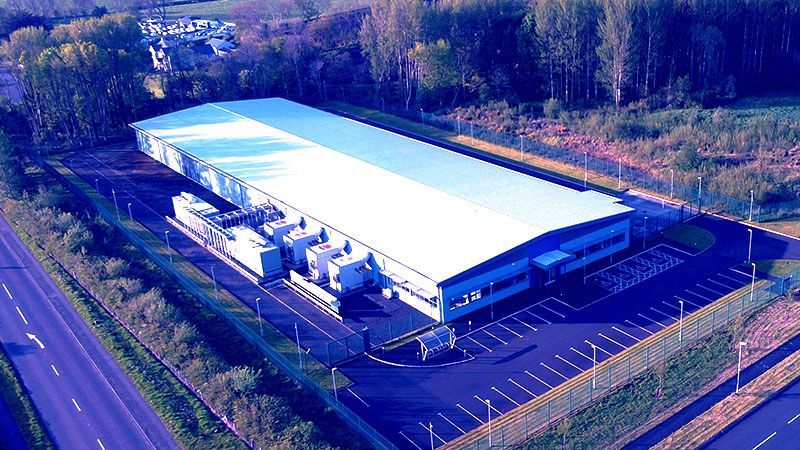
Aerial view of a data centre warehouse in the English countryside
by Duncan Clubb 13 January 2026
Author
SHOW MORE